All infographic pages · PDFCustomer personas and forecasting
Illustrative concept · Pending review. All people, visits, orders, dates and campaign examples in the image are fictional.
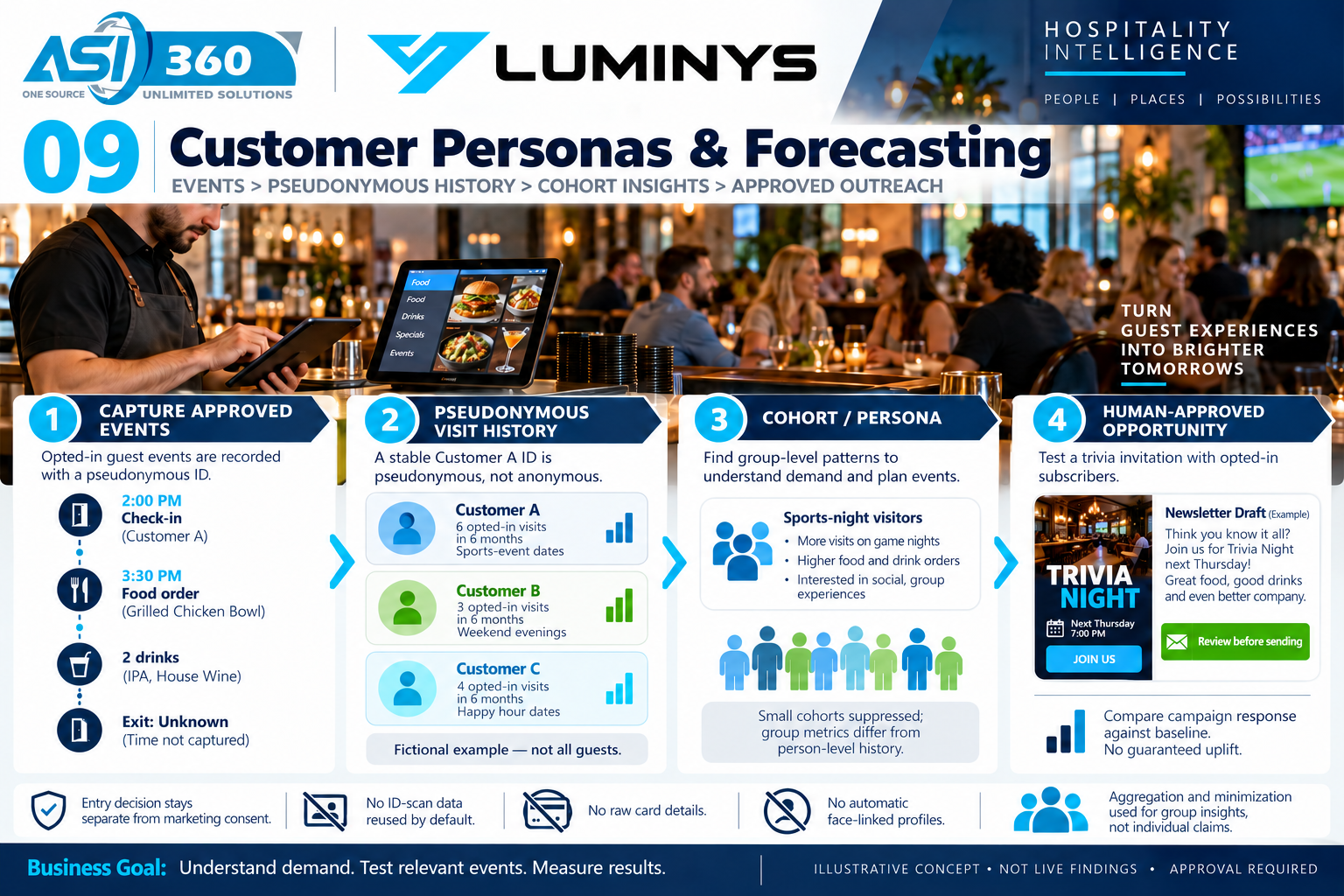
From events to a useful business question
Check-in at 2 PM, food order at 3:30 PM and two drink purchases can form a visit timeline only when supported source records are linked through an approved identifier. An ID scan alone does not supply those order events. Exit time stays unknown unless a reliable departure event is recorded.
With permission to link repeat visits, six recorded visits on sports-event dates suggest a hypothesis: a sports-night cohort might respond to trivia. That does not prove personal interests, or that a person is unaware of trivia. Test the offer and compare aggregate response, rather than treating an inferred preference as fact.
Three distinct data layers
- Pseudonymous events: restricted Customer A/B/C tokens, source IDs, time windows and approved visit/order links. A stable token can still be personal data.
- Group-level insights: minimize fields, suppress small groups and review re-identification risk. Removing names alone is not anonymization.
- Consented outreach: authorized staff may select an opted-in contact through a separately controlled CRM link. Entry checks and ID images do not automatically enroll anyone in marketing.
Newsletter draft · Fictional example · Not sent
Subject: A new night to try: trivia with friends
Enjoy game-night energy? You might enjoy our next trivia event. Bring your team and join us for an evening of questions, food and conversation.
Before use: client-approved date, venue, booking link, sender, offer and unsubscribe/preferences. Do not include a guest’s purchase or visit history in the message unnecessarily.
Forecasting: compare event calendars, cohort attendance and campaign outcomes across a defined observation window. Show sample size, missing data and uncertainty. No guaranteed demand or revenue increase.